Recreating the Chemical Traffic Light Reaction
Aaron Clarin
The City College of New York
ENGL 21007 Writing for Engineers
Professor Slentz
January 3, 2025
Abstract
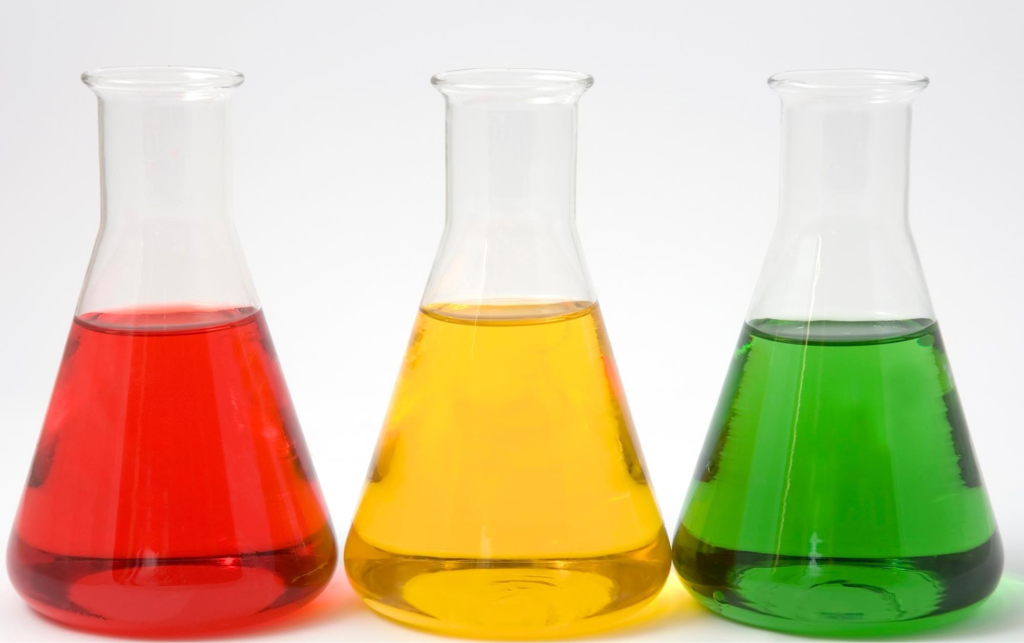
The chemical traffic light reaction demonstrates redox chemistry by showing a solution changing color between red, yellow, and green. This experiment replicates the color transitions by mixing a reducing agent (glucose) with an oxidizing agent (potassium permanganate) in a basic medium. Shaking the solution causes a color change, resulting from the alternating oxidation states of the reagents. This report details the preparation, execution, and analysis of the experiment and discusses how agitation affects the redox cycle. In conclusion, the chemical traffic light reaction offers a vivid and engaging way to explore the principles of redox chemistry and dynamic equilibrium. Through the experiment, we saw how shaking the solution introduces oxygen, triggering the oxidation-reduction cycles responsible for the striking color changes. Factors like the concentration of the reagents and the pH level also played a clear role in influencing how fast and intense the reaction occurred. This experiment not only deepened our understanding of redox processes but also demonstrated how small changes in the environment can significantly impact chemical behavior, all while showcasing the fascinating visual dynamics of chemistry in motion.
Introduction
The chemical traffic light reaction provides a visible demonstration of redox reactions, where a solution changes color between yellow, green, and red. The primary components in this reaction are glucose as a reducing agent and potassium permanganate as an oxidizing agent. These chemicals undergo cycles of reduction and oxidation, causing the solution’s color to change. This experiment explores the chemical processes behind these color changes and examines factors influencing the reaction, such as concentration, pH, and the reducing agent. This experiment highlights dynamic equilibrium in redox reactions and demonstrates how environmental factors influence chemical behavior. It is hypothesized that increasing the concentration of the reducing agent (glucose) or adjusting the pH to more basic conditions will accelerate the reaction, resulting in faster color changes due to enhanced redox activity.
Materials and Methods
Materials
- Potassium permanganate solution (0.1 M) – 50 mL
- Glucose – 10 g
- Sodium hydroxide solution (2 M) – 50 mL
- Distilled water – 150 mL
- Methylene blue (optional) – A few drops
- 500 mL glass beaker
- Stirring rod
- Glass dropper or pipette
- Rubber stopper or lid
- Gloves and safety goggles for protection
Methods
1. Preparation of the Solution
a. Dissolve 10 grams of glucose into 50 mL of distilled water to create the glucose solution.
b. Prepare 50 mL of 0.1 M potassium permanganate solution in distilled water.
c. Prepare 50 mL of 2 M sodium hydroxide solution to make the solution basic.
2. Mixing the Reagents
a. In a 500 mL beaker, add 50 mL of glucose solution and 50 mL of potassium permanganate solution.
b. Slowly add 50 mL of sodium hydroxide solution to the mixture, ensuring it becomes highly basic.
3. Shaking and Observing Color Changes
a. First, the solution appears yellow, due to the reduced manganese state in the solution.
b. Shake the beaker to introduce oxygen into the solution. The solution should turn green as the potassium permanganate undergoes partial oxidation.
c. After further shaking, the solution will turn red due to the formation of a higher oxidation state of manganese.
d. When shaking stops, the reaction reverses, and the solution slowly turns yellow as glucose reduces the oxidized manganese back to its reduced state.
4. Additional Observations
a. Methylene blue can be added as a redox indicator to visualize intermediate stages, although it’s optional.
Results
The solution initially appeared yellow, which is characteristic of reduced manganese species. Upon shaking, the solution turned green, indicating partial oxidation of the manganese. Further shaking caused the solution to turn red, indicating further oxidation. After the shaking stopped, the solution reverted to yellow, suggesting that glucose reduced the oxidized manganese species. These transitions occurred in a consistent cycle: yellow → green → red → yellow. Each color change took approximately 20–30 seconds, depending on shaking intensity.
Discussion
The chemical traffic light reaction is a fascinating demonstration for chemistry enthusiasts, educators, and students. It visually illustrates how the color changes are a result of the reduction and oxidation of manganese species. For those exploring redox reactions, this experiment offers a clear example: the yellow color represents manganese in its reduced state, the green color appears when manganese undergoes partial oxidation, and the red color reflects a higher oxidation state. The process comes full circle as glucose reduces the manganese species, making it an engaging way to learn about redox chemistry.
Several factors influence the reaction:
- Concentration: Higher concentrations of glucose or potassium permanganate lead to faster color changes.
- Agitation: Shaking introduces oxygen, speeding up oxidation.
- pH: A highly alkaline solution is necessary for the reaction to proceed with the correct oxidation states.
Conclusion
The chemical traffic light reaction effectively demonstrates the principles of redox chemistry and dynamic equilibrium. The experiment provided a clear example of how reducing and oxidizing agents interact in a reversible cycle, with color transitions visible to the observer. Further studies could involve altering the concentration of glucose, testing different reducing agents, or changing the pH to observe their effects on reaction dynamics. Other redox indicators could be tested to observe different reaction pathways or intermediate states.
References
NileRed. (2025). Recreating the Chemical Traffic Light Reaction. [YouTube Video]. https://www.youtube.com/watch?v=XXXXXXXXXXX

